Book a 30-minute audit

03:00 · nobody at the desk

Everything is getting done anyway.

MYDAS builds the systems that run your operations through the night — and keeps them running long after we hand them over.

03:07 · the overnight run

Six jobs. Nobody watching.

Statements, invoices, onboarding, tickets, billing, the morning report. All of it has to happen before nine, and none of it needs you.

03:14 · inside the run

This is the part you never see.

What happens between “a file arrived” and “it's handled”. It is not magic and it is not a black box — it is plumbing, and it is ours to keep working.

03:41 · statement intake

Your books, closed before breakfast.

Statements land, transactions match themselves, and every document files where your accountant expects to find it in March. Nobody opens a spreadsheet.

04:02 · classification

A model earns its place or it doesn't go in.

We use one where a rule cannot cope — reading a document, judging an exception, routing a mess — and a plain rule everywhere else, because a rule costs a tenth as much and never surprises you at 4am.

04:02 · rejected · code 1233

Things break at four in the morning.

Yours should catch it, retry it and clear it before anyone wakes up. We write every system to fail politely and recover on its own — the ones that don't are the ones you end up babysitting.

04:09 · cleared on the second attempt

It fixed itself, and it wrote down what happened.

Retries, backoff, a log line, and an alert only if it truly cannot proceed. You find out at nine, from a report, not at four, from a phone call.

05:40 · systems that talk

Hired once. Set up everywhere.

One signature used to mean six systems and an afternoon of copy-paste. Now the record, the accounts, the access and the payroll line all exist before their first coffee.

06:30 · everyone arrives at once

Eleven thousand orders, no queue at your end.

Traffic spikes, messages flood in, and none of it touches a human until it actually needs a decision. We build for your worst morning, not your average one.

07:15 · six of six complete

Quiet is the deliverable.

Invoices out and accepted, books closed, people onboarded, the queue drained. The measure of a good system is how little you heard from it.

07:52 · the morning report

It sends you the night in one email.

What ran, what took how long, what needed a human. Six lines you read with your coffee, or ignore entirely.

09:00 · you open the laptop

It's already done.

That is the entire promise. If your mornings start by catching up on the night before, there is a system missing — and it is probably a week's work away.


Quiet is the point.

03:00 · nobody at the desk
03:00EEST
loading the night 0%

What we build

Plumbing you never
have to think about.

Most companies do not need more software. They need the software they already pay for to talk to itself, on time, without a person in the middle. That is the whole job.

01

Operations pipelines

The jobs that run whether or not anyone is watching: intake, routing, enrichment, notifications, escalation. Built in n8n or Make, but written like software — versioned, monitored, and readable by the next person who opens them.

  • n8n · make · webhooks · queues
  • retries and alerting as standard
  • documented handover
02

Systems that talk

Your CRM, your ATS, your HR system, your helpdesk, your spreadsheets and your database, joined so that a record entered once is correct everywhere. No more Tuesday spent reconciling two lists that should have been one.

  • crm · ats · hris · helpdesk
  • two-way sync with conflict rules
  • migrations and back-fills
03

Finance automation

Invoicing from the source of truth, e-Factura submission to ANAF, statement parsing, reconciliation, and the monthly filing your accountant chases you for. Romanian compliance handled by someone who has already handled it.

  • invoicing · e-factura · spv
  • statement parsing · reconciliation
  • monthly filing, on a schedule
04

AI where it earns it

Classification, extraction, drafting and triage — used at the exact points where a model beats a rule, and nowhere else. If a regular expression does the job for a tenth of the cost, you get the regular expression.

  • document and email extraction
  • triage and routing
  • measured against the manual baseline

Where the week goes

None of this is
anybody's job.

It is the work that accumulates around the work. Nobody was hired to do it, nobody is measured on it, and it is the first thing to slip when the month gets busy — which is exactly when it costs the most.

Hands sorting a stack of printed bank statements and invoices on a desk.
The work that accumulates around the work. Nobody was hired to do it.
  • Mon 09:20

    Someone opens the bank statement and starts matching lines to invoices by eye. Four hours, every week, forever.

  • Tue 14:00

    A new hire needs an account in six systems. Five get created on Tuesday and one is remembered on Friday, by which point they have been locked out of the thing they actually needed.

  • Thu 11:45

    An e-Factura submission comes back rejected. It sits in a folder nobody owns until the deadline turns it into a fine.

  • Fri 17:30

    Two systems disagree about the same customer. Somebody picks one, writes it down, and the disagreement is still there on Monday.

  • Month end

    The report everyone waits for is assembled by hand from four exports, and the person who knows how is on holiday.

Each of these is small enough to tolerate and frequent enough to be expensive. Nobody notices the total because it never appears on one line.

The first thing we do is put it on one line. Half a day of watching one real process end to end, counted in hours rather than assumed — and if the total does not justify building anything, we will say so and you will still have the number.

Automation is not virtuous in itself. It is worth doing when the hours it returns are worth more than the thing costs to build and keep alive. That is an arithmetic question, and it should be answered before anyone writes a workflow.

What a month looks like once it runs

Quiet is a metric.

0
pipelines in production
0
jobs run without a human
0
cleared on the first attempt
0
hours handed back per month

What you actually get

Yours on day one,
not on good behaviour.

Everything runs on infrastructure you control, under credentials you hold. If we stopped answering the phone tomorrow, nothing would switch off and nothing would need buying back.

Two colleagues at one desk looking at the same laptop, one pointing at the screen.
Handover is a walkthrough with your team, not a zip file and a phone number.
The instance

Your n8n, your server, your keys

Self-hosted on your infrastructure or a VPS in your name. We work in it; we do not own it. No per-seat licence that turns into leverage later.

The workflows

Exportable JSON, in a repository

Every pipeline versioned in git with readable commits. You can diff what changed in March, and you can move the whole lot to a different host in an afternoon.

The documentation

Written for the next person

What each pipeline does, what it touches, what it costs to run, what happens when it fails, and which alert means someone has to get up. Not a diagram — instructions.

The monitoring

Alerts that reach a human

Failure alerting to the channel your team already reads, with the error and the record that caused it. A pipeline nobody is watching is a pipeline nobody can trust.

The data

It stays where it started

Records move between your systems, not into ours. Where a model is involved, we tell you which one, what it sees, and where it runs.

The exit

A month's notice, no hostages

Support is monthly and cancellable. On the way out you keep the instance, the workflows, the docs and the credentials — because they were yours the whole time.

How it goes

Three weeks from
“this is killing us”
to it running itself.

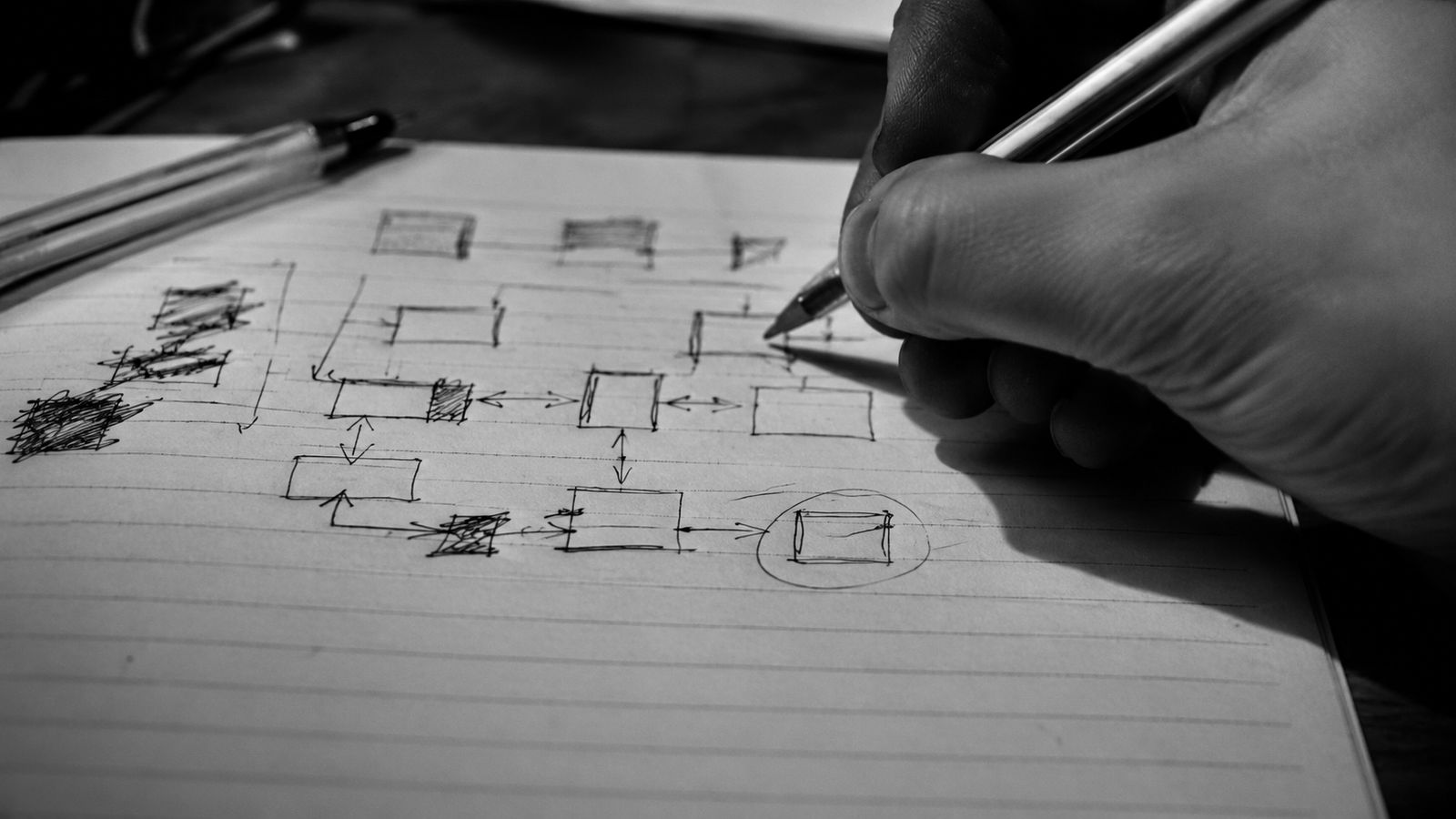
A hand drawing a flow diagram of boxes and arrows in ballpoint on a lined notebook.
Week one is a pen and a notebook, and it ends with an hours figure you keep.
01

We map the week

Half a day with the people actually doing the work — not their managers' description of it. We follow one real process end to end, count the hours it eats, list every system it touches and mark the three points where it usually goes wrong.

You get back a written map, an hours figure, and a straight answer on whether building anything is worth it. You keep all three whether or not you hire us.

week one · fixed fee
02

We build the smallest thing that removes the pain

One pipeline, in production, on your data — not a proof of concept in a sandbox that has to be rebuilt for real later. It starts on the highest-hours step from the map, because that is where the arithmetic works first.

It runs alongside the manual process at first, so you can compare the two on the same week's work before anything is switched off.

weeks two–four
03

We hand it over with the lights on

Monitoring, failure alerting, written documentation and a walkthrough recorded for whoever joins next, so your team can change a rule without booking us first.

Then we stay on call for the months when a bank changes a statement format or ANAF changes a schema — because one of them will, and the pipeline should be fixed before you notice.

ongoing · monthly, cancel anytime

Straight answers

What we will
talk you out of.

Most of the value in the first conversation is deciding what not to build. These are the ones that come up every time.

Automating a broken process

If the steps only make sense because of a decision made in 2019, a pipeline will make the wrong thing happen faster and more reliably. Fix the process first; it is usually cheaper.

A model where a rule would do

Language models are the right tool for messy input and ambiguous judgement. For anything with a fixed format, a rule is faster, cheaper, testable and does not change its mind next quarter.

Replacing the software you have

We are not going to tell you to move CRM. Nearly every problem worth solving lives between the systems you already pay for, not inside any one of them.

The dashboard nobody opens

If the answer is the same nine days out of ten, it should arrive as one line in an email on the tenth. Reporting that requires someone to go and look is reporting that stops happening.

Building it all at once

A six-pipeline programme delivered in one go arrives with six things to learn and no evidence any of it works. One pipeline in production beats six in a plan.

Work that does not pay for itself

If a process eats two hours a month, automating it is a hobby. We will tell you that on the call rather than three weeks into an invoice.

Before you ask

The questions that come up first.

What does it cost?

The mapping week is a fixed fee agreed before it starts. Build work is quoted per pipeline once the map exists, because quoting it beforehand means guessing at how many systems are involved and how badly they behave.

Support afterwards is a monthly retainer sized to how many pipelines are live. Most engagements start with one pipeline, and most clients add the second only after the first has run a full month without them.

How long until something actually runs?

The first pipeline is in production on real data inside three to four weeks of the mapping week, and running alongside your manual process rather than replacing it on day one.

Longer than that usually means the process was not one process, and we would rather split it than let a date slip quietly.

Do we need to change any of our systems?

Almost never. If a system has an API we use it; if it only has exports we work with the exports; if it has neither we will say so plainly rather than build something fragile on top of a screen.

The one thing worth checking early is whether your plan includes API access, because some vendors put it behind a tier upgrade.

What happens when something breaks at four in the morning?

Pipelines retry on their own for the failures that are worth retrying — a timeout, a rate limit, a service having a bad minute. Those never reach a person.

Anything that needs a decision raises an alert with the error and the record that caused it, in the channel your team already reads. During a support retainer that alert reaches us too.

Who owns the work?

You do, from the first commit. It runs on your infrastructure under your credentials, the workflows live in your repository, and there is no licence to keep paying for the right to run something we built.

Do you work outside Romania?

Yes — most of the work is system-to-system and does not care where anyone sits. The exception is the finance and compliance side, where e-Factura, ANAF SPV and the local filing calendar are specifically Romanian and specifically the reason people call.

Is our data going into an AI model?

Only where a model is doing work a rule cannot, and only after we have told you which model, what it sees, and whether it runs on someone else's infrastructure or yours.

Most pipelines involve no model at all. The ones that do usually use it for one narrow step — reading an unstructured document, or sorting an ambiguous message — and everything around it is ordinary code.

A person at an office window mid-conversation on the phone, backlit against the glass.

Let's talk

Tell me what is
eating your week.

Thirty minutes, no deck. Describe the process that keeps going wrong and you will leave the call knowing whether it can be automated, roughly what it costs, and whether it is worth doing at all.

If the answer is that it is not worth doing, you will get that answer on the call rather than after an invoice. The useful version of this conversation is specific, so bring the process that annoyed you most last week.

Prefer email? alex@mydassolutions.ro reaches me directly. Cluj-Napoca, EET/EEST — replies usually the same working day.

Goes straight to me. No list, no sequence, no follow-up unless you ask for one.