Baseline the business outcome
Name the operating constraint, process owner, current workflow and success measure. Decide whether the work should be eliminated, simplified, delegated or automated. Unknown values stay unknown until measured.
MYDAS implementation method
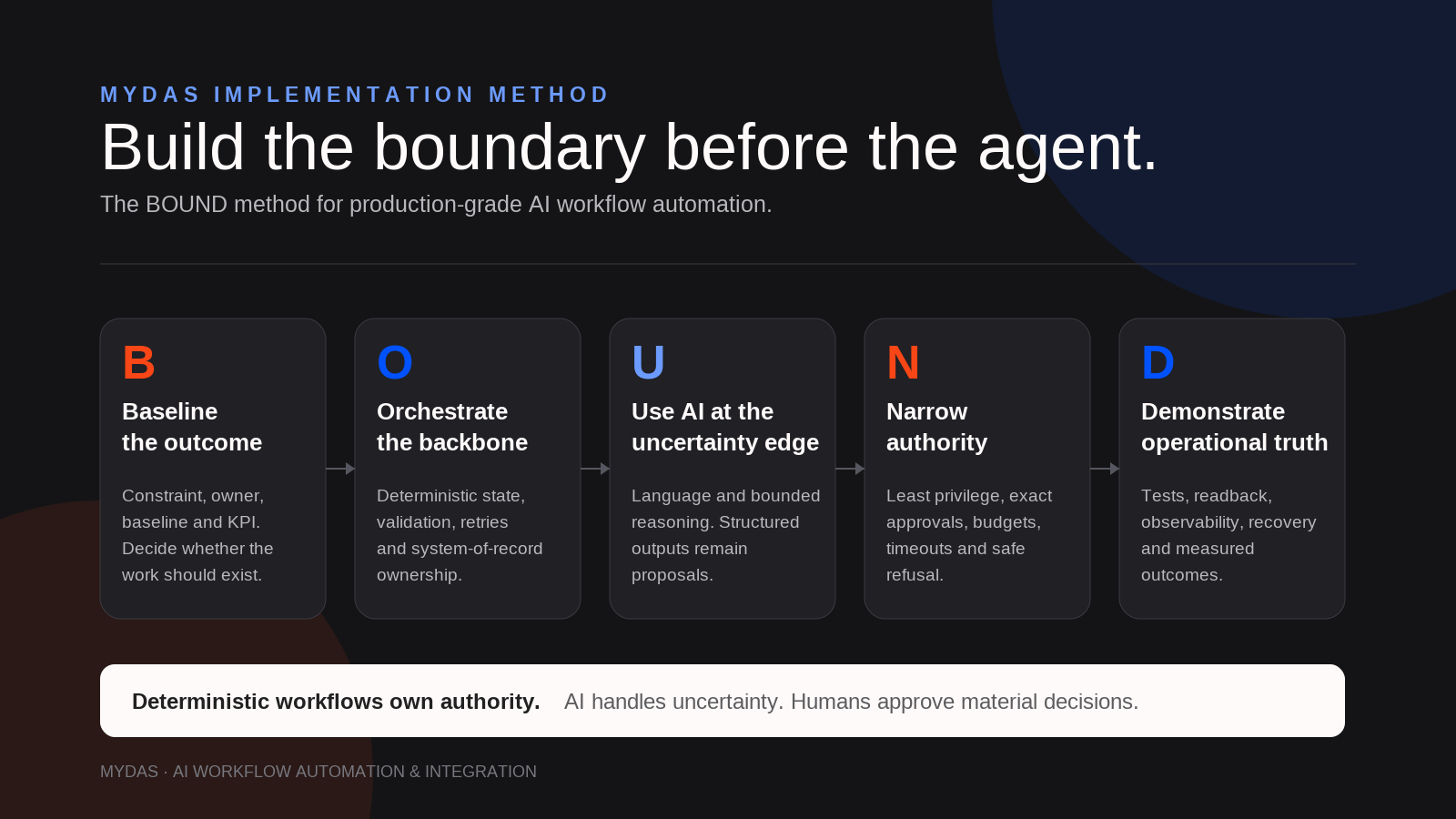
BOUND is a five-stage method for turning operational problems into reliable AI‑enabled workflows. It starts with the business outcome, keeps authority in deterministic software and requires evidence before claims.
BaselineOrchestrateUse AINarrow authorityDemonstrate
The design decision
Models are useful where language, ambiguity and incomplete context make fixed rules brittle. They are a poor place to store authority, exact values or irreversible business state.
BOUND separates those jobs. Workflows, APIs, scripts and databases own state and changes. AI handles a narrow uncertain task. Humans approve material decisions. The system records what happened.
Use AI at the uncertainty edge, not at the authority core.
The five stages
Name the operating constraint, process owner, current workflow and success measure. Decide whether the work should be eliminated, simplified, delegated or automated. Unknown values stay unknown until measured.
Give deterministic software ownership of triggers, state, validation, exact values, retries and system changes. Define the system of record and the contract at every integration boundary.
Use models for language, classification, extraction, generation or bounded reasoning. Define a narrow task, structured output, evaluation examples and a failure route.
Specify what the system may read, propose, change and never do. Apply least privilege, allowlists, budgets, scoped approvals, deadlines and safe timeout behavior.
Prove the workflow through tests, destination readback, observability and recovery. Keep simulations, production behavior and business impact separate.
Operating rules
These rules stop a convincing demo from being mistaken for a dependable operating system.
What a team leaves with
A 90-minute working session applies the five stages to one real process. The output is specific enough to build, test and reject if the case is weak.
What this page claims
A repeatable way to design an automation, separate uncertain reasoning from authority, define failure behavior and require operational evidence before declaring success.
It does not manufacture an ROI case, remove the need for domain judgment or make every process worth automating. Some work should be simplified or stopped instead.
Start with one process
We will identify the constraint, decide what should remain deterministic and define the narrowest safe role for AI.